top of page



The Legend of Man Ó Cléirigh
After an amnesiac discovers a mysterious abalone in Ireland, he hungrily navigates the island's blight-ridden landscape in search of any connection to his past.

Q and A:
Q: Why the physical and mixed media format?
A: My goal was to make something tangible. Not only as a writing sample, but because the story of the Great Hunger in 1840s Ireland was very real. I think sometimes we forget that history is also form of storytelling, whether it be folk, horror, fantasy. Reflective of the time period, I think the medium between reader and story shrinks when you read something the way people did back then, on the page.
Q: What prompted the visuals?
A: Maybe I was procrastinating writing, but I also knew I wanted to supplement the story with a visual component, hence the illustrations and video. I'm used to writing for the screen, so writing in prose was an intimidating format. I wanted to bring audiences closer to the story and peek in through a window... Even though I hadn't drawn since I was a little kid.
Q: Who made the video?
A: This guy on Instagram called dogxwillxhuntx. He makes 3D art and retro video-game-aesthetic content. I commissioned him and used my illustrations for reference since I hadn't completed the story yet. Stuff like that is my favorite because it's such a modern take on visual storytelling, and its own kind of folklore. It's nostalgic from a time when I played computer games as a kid. Plus, it's rad to look at, so I wanted it to be part of my story.
Q: Were there any "aha moments", or things you learned about the time period generally?
A: Yes, one being a revelation around the symbol of the spiral. The Celts created one of history's oldest symbols called the triskelion, or triskele, which is a triple spiral. It was arguably replaced by Christian dogma, representing the "Father, Son, and Holy Spirit" in the form of a shamrock. So the triskele had many meanings, one being the idea of life, death, and rebirth, which in some ways, is emblematic of any three-act story, but definitely this one.
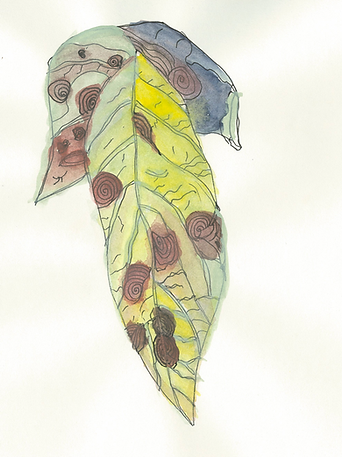
The spiral showed up when I was researching how the potato crop actually died, and discovered that blight creates a mesmerizing spiral shape on the leaf of the plant if affects. Even crazier, I discovered that the first galaxy ever recorded by Lord Parsons was named the Whirlpool Galaxy (after I had already written the scene where Barry references how still the "whirlpool" was in the cave). Parsons was essentially the guy who discovered that galaxies are spiral-shaped, so I thought I'd spiral-bind the book too.
Q: Were any characters or events actually real?
Lord William Parsons was a real guy and so was his wife, Mary, as well as the Castle Birr, and his Leviathan telescope. He truly had thirteen children, although little is known about them. I hope people look him up, because I was satisfied blending his real accounts with the fiction of Ó Cléirigh and Barry. I think it's interesting he was able to focus on science while the rest of the country was depleting.
Of course, the devastation of Ireland was very real and many details are hopefully quite accurate. Specifically, the soup kitchens. Protestants would give room and board to many Irish Catholics under the condition that they convert their faith, and serve soup under the same guise. Newgrange is real and older than Stonehenge, the Easter Island Heads, and the Pyramids.




3D-generated composite image of the handmade illustration on the right
Recreation of Lord William Parsons' "Whirlpool Galaxy", marking the discovery of the shape of our universe
The spiral shape appears in nature, including the blight that largely caused The Great Hunger
bottom of page